Advocacy and Conservation Accomplishments
A Local Club. A Provincial Voice. A Fight for the Future of BC’s Fish and Wildlife.
A conservation crisis decades in the making
British Columbia is one of the most biologically diverse jurisdictions in North America. Yet its investment in fish, wildlife and habitat management has fallen dramatically over many decades.
The BC Wildlife Federation has been making the case for years: British Columbia needs reliable, dedicated funding, independent science-based management and a government that treats fish and wildlife conservation as an essential responsibility.
The consequences of chronic underinvestment are increasingly apparent: threatened salmon stocks, declining mule deer and moose populations, species at risk, chronic wasting disease, invasive species and degraded habitat.
The problem has been understood by conservationists for a long time. The challenge has been getting governments to act.
BCWF: building the case and building a coalition
The BC Wildlife Federation has not fought this battle alone. It has brought together conservation organizations, hunting and angling interests, businesses, watershed groups and other partners to create a broader provincial voice.
Two important examples are:
- The Fish, Wildlife and Habitat Coalition: more than 25 organizations and 900 businesses, collectively representing more than 273,000 British Columbians.
- The BC Watershed Security Coalition: more than 57 organizations, representing more than 285,000 British Columbians.
These coalitions bring together interests that share a concern for healthy ecosystems, functioning watersheds and the future of British Columbia’s fish, wildlife and habitat.
BCWF has helped turn a long-standing conservation concern into a coordinated provincial campaign.
A major breakthrough: the 2026 provincial election
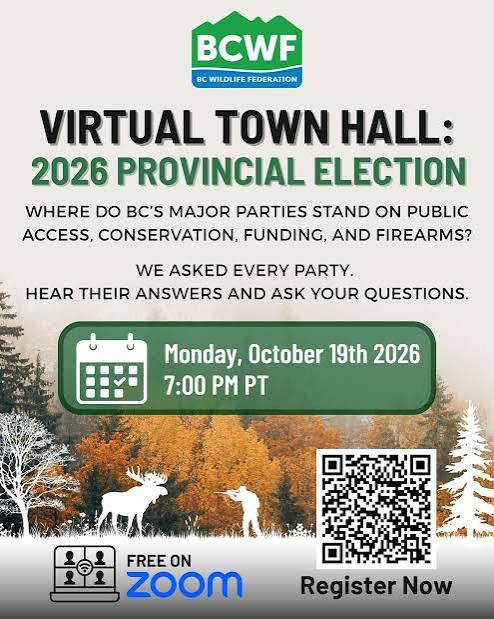
BCWF took its priorities directly to the political parties during the 2026 provincial election.
The Federation developed a detailed set of questions and sought written commitments from candidates and parties on public access, conservation funding, wildlife management and firearms policy.
Member clubs were encouraged to contact every candidate in their ridings, put the questions before them and share the answers with their members before voting.
North Shore Fish & Game Club participated directly. Our club contacted candidates throughout the Lower Mainland, presented the BCWF questions and made their responses available to members before the election.
This process mattered. Candidates understood that these issues were being raised across the province, that their answers would be seen by an organized membership and that hunters, anglers and conservationists intended to take those answers into account when voting.
The Conservative Party of BC subsequently made written commitments to a substantial number of BCWF’s priorities.
After years of pressing governments to address the conservation funding crisis, BCWF had secured meaningful political traction for its agenda.
Commitments secured from the Conservative Party of BC
The party’s written response to BCWF included commitments to:
Public access
- Enshrine public access to Crown land, beaches and the backcountry in legislation, subject to legitimate conservation and safety requirements.
Independent, science-based wildlife management
- Establish an independent Fish and Wildlife Commission.
- Establish sustainable, science-based fish and wildlife population objectives.
- Work with hunters, anglers, First Nations and conservation organizations to improve wildlife management.
Conservation funding
- Dedicate hunting licence and tag revenues to fish and wildlife management.
- Put more conservation officers in the field.
Prescribed burning and habitat
- Support prescribed and cultural burning.
- Report annually on hectares treated.
- Reduce unnecessary regulatory barriers to prescribed burning.
- Support improved water storage, drought preparedness and watershed management.
Firearms policy
- Focus provincial policing resources on illegal firearms, organized crime and public safety rather than diverting resources to the federal firearms confiscation program.
These commitments represent substantial progress in getting BCWF’s priorities recognized by a major provincial political party.
They are commitments, not yet completed reforms. The work now is to ensure they are implemented.
The funding challenge remains
BCWF has long argued that British Columbia needs permanent, dedicated funding for fish, wildlife and habitat management.
Its proposal is for $200 million annually.
That is a modest investment in the context of the provincial budget, but it could provide the foundation for a much larger conservation program. Through partnerships, matching contributions and other funding sources, BCWF believes that investment could be leveraged by as much as seven times.
The proposal includes:
- Permanent, dedicated funding insulated from annual political budget decisions.
- An independent Fish and Wildlife Commission.
- Legislated population objectives.
- A $1 billion Watershed Security Fund.
- A commitment to 50,000 hectares of controlled burns annually.
The Conservative commitments are an important step, but they do not yet deliver the full funding model BCWF has proposed. Securing that investment remains a central priority.
What this means for NSF&G members
North Shore Fish & Game Club does not operate a separate provincial advocacy program. Our advocacy is part of the larger BCWF effort.
Our members contribute to that effort by:
- Bringing local issues and experience to the Federation.
- Participating in provincial advocacy campaigns.
- Contacting elected representatives and candidates.
- Sharing information and encouraging informed participation.
- Supporting the collective voice of BCWF and its member clubs.
The recent election demonstrated what that collective voice can accomplish. A local club can put questions to candidates. Hundreds of thousands of people represented through coalitions can bring broader public attention to conservation issues. A provincial federation can turn those concerns into a coherent political agenda.
This is what membership makes possible.
The BCWF has been fighting for better conservation management and funding for decades. Its members and partners are now getting traction.
NSF&G is part of that effort, and our members have every reason to take pride in it.
The work continues.
Our Conservation Projects
Local Action. Tangible Results. A Lasting Contribution.
Conservation isn’t just something we talk about. It’s something we do.
North Shore Fish & Game Club supports practical, hands-on projects that benefit fish, wildlife and habitat. Some of that work happens close to home, along the creeks and green spaces of the North Shore. Some connects our members to larger conservation research projects across British Columbia.
These projects reflect what a local club can accomplish when members contribute their time, knowledge and resources.
MacKay Creek Salmon Hatchery
Giving chum salmon a helping hand
One of our most recent projects involved collecting and fertilizing approximately 45,000 chum salmon eggs and placing them in the NSF&G hatchery at MacKay Creek.
This hands-on work gives members an opportunity to participate directly in salmon stewardship and learn about the early stages of the salmon life cycle.
The hatchery is a practical way to connect our community to the salmon that are part of our local watersheds. It also gives us an opportunity to share that experience with others and build a greater appreciation for the fish and habitat that sustain them.
<em>Approximately 45,000 chum salmon eggs — collected, fertilized and placed in our MacKay Creek hatchery.</em>
Chickadee Nest Boxes Along MacKay Creek
Creating habitat close to home
NSF&G has also installed and maintained nesting boxes for chickadees along MacKay Creek.
Natural nesting cavities can be limited in some environments. Nest boxes provide additional nesting opportunities and help support local cavity-nesting birds.
It’s a relatively simple project, but one that gives members a direct connection to the wildlife living alongside our local waterways. It also offers an opportunity to encourage curiosity about birds, habitat and the small things that contribute to a healthy ecosystem.
Supporting the Southern Interior Mule Deer Project
Better science. Better wildlife management.
NSF&G has contributed funding to the Southern Interior Mule Deer Project (SIMDeer) by purchasing a radio collar to support this important research initiative.
Led by the BC Wildlife Federation in collaboration with the Okanagan Nation Alliance, universities and provincial wildlife researchers, SIMDeer is studying mule deer across approximately 30,000 square kilometres of British Columbia’s southern Interior.
The research examines deer movements, migration, survival, reproduction, habitat use and the influence of predators and landscape changes.
Radio collars provide researchers with valuable information about where deer travel, which habitats they use and, when mortality occurs, where and potentially why an animal has died. This information helps researchers identify the factors affecting mule deer populations and develop better management recommendations.
Mule deer populations have declined in parts of the Southern Interior. Understanding the reasons is essential to making informed management decisions.
By purchasing a collar, NSF&G has made a direct contribution to a much larger, science-based conservation effort.
Learn more about the Southern Interior Mule Deer Project.
Conservation Starts With Participation
These projects are examples of what our club can accomplish through the contributions of its members.
Some projects involve collecting fish eggs, maintaining a hatchery or installing nest boxes. Others involve supporting scientific research and conservation initiatives far beyond our local community.
They have something important in common: people who care about fish, wildlife and the outdoors choosing to get involved.
We welcome members who want to contribute their time, experience, skills or ideas. You don’t need to be a biologist or a conservation professional to make a difference.
Conservation is a shared responsibility. And it starts with people willing to participate.